

Lucy
The story about The Beatles' song Lucy in the Sky with Diamonds, and a fictitious story about a girl named Lucinda

The story of Lucinda
‘How are you feeling, dear?’
Lucinda feels sick and tired, literally. ‘Fine,’ she manages, smiling.
Her mom takes a seat on the chair next to the hospital bed. ‘Dr. Martens said the therapy is going well.’
This is not strictly true. The doctors say that if Lucinda doesn’t respond well to the chemotherapy, it is only a matter of time; that if she won’t fight, her kidneys won’t be saved.
It’s not cancer. The disease she has is called Systemic Lupus Erythematosus. The drugs bludgeon the immune system – brutal, but effective. Lucinda has had the condition since she was five. Her mother still feels guilty for not getting a check-up earlier. Onset of lupus in childhood is considered more severe and can cause more damage to the internal organs over time. When she was diagnosed at the age of nine, blood tests and a kidney biopsy revealed she was at risk of losing her kidney functions. The chemotherapy wasn’t the immediate choice. First, Lucinda was given steroids in high doses, which resulted in mood changes, increased appetite and growth suppression. But by the age of ten, Lucinda’s disease still wasn’t under control, and her kidneys were failing.
‘I’ve brought you a book,’ says her mother, pulling a small hardback from her handbag.
Lucinda reads the cover: Alice’s Adventures in Wonderland & Through the Looking-Glass. Her mother knows that she reads a lot. Lucinda is tired of reading, too. Too often, it has been her only way to pass time, time that runs slowly and yet is not enough.
‘Thanks,’ Lucinda says, holding it tight.
‘I’ll let you get some rest,’ says her mother.
Lucinda does. When she wakes, it is the middle of the night. The curtains are not pulled, and the night is clear, though she doesn’t see the stars. Too strong is the light emanating from the hospital buildings. Lucinda is still clutching the little book in her fingers. With a sigh, she straightens up in her bed and switches on the reading lamp. She already knows Alice’s Adventures in Wonderland and turns to Through the Looking-Glass. She skips the first pages containing a chess game, she doesn’t play chess, and jumps directly into the looking-glass house. By the time she’s read past the flowering garden to the looking-glass insects, her eyelids are heavy, but the mind is still eager. She flicks through the pages to a drawing of Alice and a sheep in a boat. That’s curious, she thinks, halting her page-turning to find her bearings. Alice and the sheep are gliding through a landscape in a boat, sweet-scented rushes along their way, talking about feathers and knitting needles and… the boat glides gently down the river, the sun in the sky, and she squints up at it. But wait, it is not the sun. It is the bright beam of sparkling eyes that belong to a girl, a very large girl, looking down at her, and something that looks like… a reading lamp? She feels somewhat intimidated, being so small in this boat with such a large head hovering over her. And all alone in this boat. The sheep that was there beside her one moment is gone the other. It must have jumped out when she wasn’t watching. She wonders whether she should jump, too, but the girl up there appears friendly.
‘What are you doing up there?’ she asks the girl.
The girl’s eyes become even larger. ‘I am reading,’ says the girl.
‘What about?’
‘About you,’ says the girl.
‘That’s strange,’ she says. ‘How is it then that you are talking to me?’
‘I don’t know,’ the girl says. ‘I am as surprised as you are.’
‘You have very big eyes,’ she says. The eyes are mostly what she sees of the girl, illuminated by the lamp up there, the rest of her lies in darkness.
‘They might appear big to you,’ the girl with the very big eyes answers.
‘They shine like stars in a night sky up there. Or diamonds. I think they shine even brighter because there is a lot of darkness around you.’
‘Thank you,’ the girl says. ‘But you look sad all of a sudden.’
‘I’m sad, yes,’ she says. ‘You’re out of reach. It is like you are… in another realm. In another life.’
‘Look at you!’ exclaims the girl. ‘Embarking on all those adventures… It is a life I can only dream of. Whyever would you want my life? If anything, I want to swap with yours! I can’t remember a day where I was not in pain. Swollen joints, rashes, hair loss, fatigue, anaemia, pain in most parts of my body. ’
‘You are right. It doesn’t sound like fun.’ She thinks what to say. ‘Do you ever have a good day?’
‘I’m sure there must have been one, sometime, somewhere, but it’s lost to me now.’
‘But when you read about my adventures, do you have fun then?’
‘I do,’ says the girl.
‘And you can read many more adventures, of all sorts of people.’
‘That indeed is true,’ says the girl. ‘But I’ve read so many adventures. I’m getting tired of it. I wouldn’t mind sticking with just the one.’
She suddenly knows what to do. ‘Let’s do it,’ she says.
‘What do you mean?’ asks the girl.
‘Let’s swap our places. You’ll come here and glide along the river in the boat. I’ll come over to you and see the world with your eyes. I’m sure there is a lot of world to see with such big eyes.’
‘Are you for real?’
‘As real as you.’ She stretches up towards the night sky, to the giant figure, reaching out her pinkie finger.
Simultaneously, a huge pinkie descends from the night sky, becoming smaller and smaller until it is in reach of my outstretched arm, and they hook it together. The world around her starts swirling, colours breaking into fragments like in a kaleidoscope, the pages turn upside down and she is pulled back, staring down onto the page. The image is still. Was it a dream?
The girl in the boat on the drawing winks at her. ‘So now you’re there,’ the girl says. ‘And I’m here. What are you going to do next?’
‘It… hurts,’ she says.
‘Told you so,’ the girl answers. ‘But now that I see you up there, I understand what you said. In darkness, you shine even brighter. Perhaps that is true for everything. We only see the stars because of the dark.’
It is dark around her when she opens her eyes. This time she is certain it was a dream. The book is still in her hands, the light has been switched off. Maybe the night nurse came by. She looks out at the night sky. Something has changed. The stars are visible, and they are twinkling, twinkling like the girl’s eyes.
This post is brought to you free of charge. Consider making a donation to:
The story of the song
Sgt. Pepper’s Lonely Hearts Club Band purportedly marks The Beatles’ psychedelic phase. It is often speculated that this was brought on by the rise of the psychedelic drug that the Swiss chemist Albert Hoffmann developed in 1938 for Swiss pharmaceutical company Sandoz, Lysergic Acid Diethylamide (German: Lyserg-Säure-Diethylamid, short LSD). Albert Hoffmann’s first self-experiment in 1943 is to this day commemorated as Bicycle Day (April 19). In the anglophone world, psychologists Timothy Leary and Robert Alpert (later better known as Ram Dass) as well as writer and self-styled ‘philosophical entertainer’ Alan Watts popularised Eastern spirituality and drug-induced exploration of consciousness. They trailblazed an era of musical, artistical, cinematographical and social change associated with the proliferate consumption of LSD that lasted approximately from the mid-1960s to the mid-1970s.
The Beatles’ psychedelic phase, too, was marked by an interest in Eastern philosophies and experimentation with drugs. John Lennon, George Harrison and their then-or-soon-to-be wives, Cynthia Lennon and Pattie Boyd, purportedly first took LSD unknowingly when their coffee was spiked by a dentist following a dinner in 1965. For Harrison, this was a profound experience, and although they all panicked at first, he later recalled: ‘I had such an overwhelming feeling of well-being, that there was a God, and I could see him in every blade of grass. It was like gaining hundreds of years of experience within twelve hours.’ John Lennon’s own experimentation with the drug that would ultimately end his marriage hit its peak during the recording of Sgt. Pepper. In the summer of 1967, Paul McCartney admitted his recreational use of LSD to several news outlets, inconveniencing the other Beatles in confirming their drug use and causing a righteous public outcry similar to that following John Lennon’s 1966 interview with the throwaway comment ‘more popular than Jesus’. More importantly, The Beatles were no longer the four cute mop tops that they had become known as. They were no longer boys, three of them had married, two had become fathers, and all were following their own interests. By the time they went into the studio for Sgt. Pepper, they were at a crossroads. Perhaps this led to the need of submerging their own identities in a fictional band called the Lonely Hearts Club. However, Sgt. Pepper was mainly Paul McCartney’s vision, influenced predominantly by American blues, Motown, Beach Boys and Frank Zappa. George Harrison and John Lennon were less enthusiastic. Both, however, contributed their individual ideas, albeit bending them to the album’s overall concept. George had started taking sitar lessons from Ravi Shankar and his interest in Indian music had a notable effect on The Beatles’ sound. John chose several influential figures, including Aldous Huxley, for the album’s cover art and wrote two songs, though he later said he didn’t like the final mix.
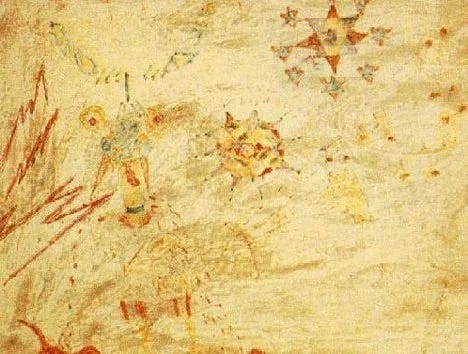
Lucy In The Sky With Diamonds is one of these two contributions, the third track on the band’s 1967 album. Though the song lends its name to another slang name for LSD, lucy, John Lennon apparently did not write the lyrics with this in mind: ‘I had no idea it spelt LSD. This is the truth: my son came home with a drawing and showed me this strange-looking woman flying around. I said, “What is it?” and he said, “It’s Lucy in the sky with diamonds,” and I thought, “That’s beautiful.” I immediately wrote a song about it.’
Paul McCartney corroborates this story in Anthology: ‘I showed up at John’s house and he had a drawing Julian had done at school with the title “Lucy In The Sky With Diamonds” above it. Then we went up to his music room and wrote the song, swapping psychedelic suggestions as we went. I remember coming up with “cellophane flowers” and “newspaper taxis” and John answered with things like “kaleidoscope eyes” and “looking glass ties”. We never noticed the LSD initial until it was pointed out later – by which point people didn’t believe us.’
The girl in Julian Lennon’s drawing was Lucy O’Donnell, a four-year-old child at the Heath House nursery in Weybridge, Surrey. The O’Donnell’s remember Julian being dropped off in a Rolls Royce. Lucy later went to school in Weybridge, college in Guildford and then moved to Surbiton, all within an eleven-mile radius. Lucy studied to become a nurse for children with special needs and later ran her own agency. She married her childhood sweetheart Ross Vodden in 1996. Julian Lennon, whom she had had little contact with since their childhood days, sent a note.
In her thirties, Lucy began to suffer from psoriasis and Systemic Lupus Erythematosus (short SLE or lupus), an autoimmune disease that causes inflammation and attacks healthy tissue and organs. In September 2009, at the age of forty-six, her body was weakened so severely by this condition that she lost her battle against it after contracting an infection on her first holiday in eight years that took her and her husband to Norfolk. Julian Lennon, who had heard from her illness and come to her aid in the months prior to her death, along with her family and people who knew her were devastated.
The song, Lucy had said, was the least important thing about her, but if she could raise awareness for the vicious disease that still doesn’t have a cure, she would.
John Lennon, the songwriter, whilst immediately called on to write a song by his son’s beautiful artwork, didn’t necessarily have Julian’s playmate in mind. Rather, he took his inspiration from Through the Looking-Glass: ‘It was Alice in the boat. She is buying an egg and it turns into Humpty-Dumpty. The woman serving in the shop turns into a sheep and the next minute they are rowing in a rowing boat somewhere and I was visualizing that.’ Lennon references chapter five Wool and Water, in which Alice meets the White Queen and goes on a boat trip with her. A boat trip is prevalent in the poem at the end of Lewis Carroll’s 1871 novel, too. Moreover, its predecessor, Alice’s Adventures in Wonderland, was conceived during a boating trip the mathematician Charles Dodgson (the man behind the pen name Lewis Carroll) undertook with the ten-year-old Alice Lidell and her sister. Its dreamlike, even hallucinatory scenes have often raised the question whether Dodgson could have been describing the effects of drugs. Though LSD was not synthesised until later, hallucinogenic mushrooms and opium were common ground in the nineteenth century (the first well-documented experiments with hallucinogenic mushrooms in Britain took place in 1799, and opium or laudanum, a mixture of opium and high-proof alcohol, where widely available from the eighteenth century onwards). Children’s literature experts, however, remain sceptical of the theory.
Lucy In The Sky With Diamonds was not the only 1967 song to be influenced by Alice’s adventures. Earlier that year, Jefferson Airplane had released their psychedelic anthem White Rabbit. References to Lewis Carroll’s work are also prevalent in more recent popular culture, such as in the 1999 film The Matrix, where a white rabbit and the colour of pills – mind-numbing blue or consciousness-expanding red – define Neo’s fate, or in the spinning top and dice totems used to distinguish reality from dream in 2010’s Inception.
The Beatles’ song is structured in two distinct parts: the dreamlike verses, hallucinatory in their quality, flow with a 6/8 time that switches to a 4/4 in the chorus. Paul McCartney said about it: ‘We did the whole thing like an Alice in Wonderland idea, being in a boat on the river ... Every so often it broke off and you saw Lucy in the sky with diamonds all over the sky. This Lucy was God, the Big Figure, the White Rabbit.’
Head over to my website and sign up for my newsletter for a 90 day free trial of a paid subscription to my Substack (I promise I will not spam you):
Background & research
Lyrics
ML Genius Holdings, LLC. (n.d). The Beatles – Lucy in the Sky with Diamonds. [online] Available at: https://genius.com/The-beatles-lucy-in-the-sky-with-diamonds-lyrics [Accessed August 2025].
Through the Looking-Glass: Chapter 5 synopsis, the chess problem and the final poem
In the fifth chapter, Wool and Water, Alice (in the accompanying chess game, a white pawn currently standing on Q 4th) meets the White Queen who lives backwards, remembering things before they happen (in the accompanying chess game, the White Queen is enacting a move to QB 4th, bringing her figure next to Alice’s). The White Queen turns into a knitting sheep sitting behind a counter in a shop in which things are always just out of reach for Alice before, prompting the sheep to call her a teetotum, then her knitting needles turn into oars, and they row in a boat down a river with high riverbanks and many weeds with scented rushes, but here, too, the loveliest ones are always just out of reach. (In the chess game, during this interchange both Alice’s pawn and the White Queen move in their respective columns to row 5.) The sheep calls her a goose and tells her she caught a nice crab, though Alice doesn’t understand and instead finds herself standing back in the shop, buying an egg that the sheep leaves on a shelf (White Queen moves diagonally to KB 8th). In the next chapter, you’ve guessed it, the egg becomes Humpty Dumpty (and Alice continues her straight line to the other end of the board, where the white pawn will turn into a queen).
The chess game uses an older notation. The numbers one to eight denote the rows, counting upward from whichever side of the board you are sitting on (i.e., white or red). The columns are denoted as follows, from left to right:
Q R – queen’s side rook
Q Kt – queen’s side knight
Q B – queen’s side bishop
Q – queen
K – king
K B – king’s side bishop
K Kt – king’s side knight
K R – king’s side rook
The game starts with Alice’s pawn on Q’s 2nd and the White Queen on Q B’s 1st.
By the chapter Wool and Water, Alice’s pawn has moved two squares up the Q column to Q’s 4th, whereas the White Queen makes her first move to Q B’s 4th. Rather than red and white taking alternate turns in the game, Alice plays her moves alternately to other figures on the board, with one exception when the Red Knight is taken by the White Knight. The game ends when Alice, after a coronation and a series of ‘castling’ moves now moving across the board like a queen rather than a pawn, takes the Red Queen (instead of check-mating the king). The kings don’t move during the entire game.
As Lewis Carroll wrote himself in the preface of the 1887 edition of Through The Looking Glass: ‘As the chess problem, given on the previous page, has puzzled some of my readers, it may be well to explain that it is correctly worked out, so far as the moves are concerned. The alternation of Red and White is perhaps not so strictly observed as it might be, and the “castling” of the three Queens is merely a way of saying that they entered the palace; but [some of the moves] will be found, by anyone who will play the moves as directed, to be strictly in accordance with the laws of the game.’
Through the Looking Glass ends in these famous lines:
‘A boat, beneath a sunny sky,
Lingering onward dreamily
In an evening of July –
Children three that nestle near,
Eager eye and willing ear,
Pleased a simple tale to hear –
Long has paled that sunny sky;
Echoes fade and memories die;
Autumn frosts have slain July.
Still she haunts me, phantomwise,
Alice moving under skies
Never seen by waking eyes.
Children yet, the tale to hear,
Eager eye and willing ear,
Lovingly shall nestle near.
In a Wonderland they lie,
Dreaming as the days go by,
Dreaming as the summers die;
Ever drifting down the stream –
Lingering in the golden gleam –
Life, what is it but a dream?’
References
1. IDAC Media PC (2017). Lupus Trust UK. [online] Lupus Trust UK. Available at: https://www.lupus.org.uk/patient-stories/patients-stories/99-lucy-s-story [Accessed August 2025].
2. The Beatles Bible. (2008). Lucy In The Sky With Diamonds. [online] Available at: https://www.beatlesbible.com/songs/lucy-in-the-sky-with-diamonds/ [Accessed August 2025].
3. The Revolver Club (2024). How an LSD-Spiked Coffee Gave Birth To The Beatles’ Revolver. [online] The Revolver Club. Available at: https://www.therevolverclub.com/blogs/the-revolver-club/how-an-lsd-spiked-birthed-the-beatles-revolver [Accessed August 2025].
4. Wikipedia Contributors (2024). Bicycle Day (psychedelic holiday). [online] Wikipedia. Available at: https://en.wikipedia.org/wiki/Bicycle_Day_(psychedelic_holiday) [Accessed August 2025].
5. Starkey, A. (2021). George Harrison and John Lennon’s first acid trip. [online] Far Out Magazine. Available at: https://faroutmagazine.co.uk/george-harrison-and-john-lennon-first-lsd-trip/ [Accessed August 2025].
6. Wikipedia Contributors (2024). See Yourself. [online] Wikipedia. Available at: https://en.wikipedia.org/wiki/See_Yourself [Accessed August 2025].
7. Gilmore, M. (2017). Inside the Making of the Beatles’ ‘Sgt. Pepper’. [online] Rolling Stone. Available at: https://www.rollingstone.com/music/music-features/inside-the-making-of-sgt-pepper-125417/ [Accessed August 2025].
8. Beatles Bible (2024). The Sgt. Pepper Sessions | Beatles Documentary Film. [online] YouTube. Available at: https://www.youtube.com/watch?v=JYy9RD_VksE [Accessed August 2025].
9. Beatlesinterviews.org. (2019). John Lennon Interview: Playboy 1980 (Page 1) - Beatles Interviews Database. [online] Available at: http://www.beatlesinterviews.org/db1980.jlpb.beatles.html [Accessed August 2025].
10. Beatlesinterviews.org. (2019). John Lennon Interview: Playboy 1980 (Page 3) - Beatles Interviews Database. [online] Available at: http://www.beatlesinterviews.org/dbjypb.int3.html [Accessed August 2025].
11. The Paul McCartney project. (2020). Interview for The Observer (Sunday, November 26, 1967, interviewed by Alan Aldridge). Paul McCartney: What do The Beatles Mean ? [online] Available at: https://www.the-paulmccartney-project.com/interview/paul-mccartney-what-do-the-beatles-mean/ [Accessed August 2025].
12. Is Alice in Wonderland really about drugs? (2012). BBC News. [online] 20 Aug. Available at: https://www.bbc.com/news/magazine-19254839 [Accessed August 2025].
13. Carroll, L., Tenniel, J. and South, A. (2016). Alice’s adventures in Wonderland ; & Through the looking-glass and what Alice found there. London: Macmillan Collector’s Library.
References are now produced with:
MyBib Contributors (2019). Harvard Referencing Generator – FREE – (updated for 2019). [online] MyBib. Available at: https://www.mybib.com/tools/harvard-referencing-generator.